Thinning hair is not one diagnosis: diffuse loss across the scalp, a receding hairline and a widening crown create different surgical problems. By the end, you will know which findings support transplantation, which require medical investigation first, and what donor supply, coverage limits and recovery involve.
Key takeaways
- A transplant redistributes follicles; it cannot create new ones or restore teenage density.
- Diagnose the cause and confirm stable loss before considering surgery.
- Donor density determines how much thinning hair you can realistically cover.
- Judge FUE growth after new hairs mature, not during early shedding.
Which pattern of thinning can a transplant actually address?
A hair transplant for thinning hair is suitable when loss follows a diagnosed, stable pattern and the donor area contains enough dense, reliable follicles to redistribute. It does not create new follicles or restore teenage density, so diffuse loss requires more caution than a clearly defined bald area.
| Pattern | What it means | When surgery may fit |
|---|---|---|
| Diffuse thinning | Hair density falls across the top and may also affect the donor region. | Suitable only when the donor zone remains relatively preserved and the cause is confirmed. Diffuse alopecia, telogen effluvium, alopecia areata, thyroid disease, iron deficiency and scalp inflammation need investigation first. |
| Receding hairline | The front corners or central hairline move backward while the sides and back remain denser. | Often the clearest transplant pattern, provided androgenetic alopecia is stable and the planned hairline is conservative. Reserve donor hair for future recession. |
| Thinning crown | Density decreases around the whorl at the back of the scalp. | Technically possible, but the broad rounded area can consume many grafts. Hair direction, the whorl and future loss must guide planning. |
A scalp examination should confirm the diagnosis before surgery, especially when loss is rapid, patchy or inflamed. Female-pattern loss is suitable only for selected patients; when thinning includes the donor region, medical management often comes first.
Crown surgery also does not stop original hair from thinning, which can leave transplanted grafts surrounded by gaps unless loss is stabilised.
What must be diagnosed before you consider surgery?
A hair transplant for thinning hair starts with a diagnosis, not a graft count. The clinician takes a history of when shedding began, its speed, family pattern, recent illness, weight change, medication use and scalp symptoms. Age, hair calibre and family history help distinguish inherited pattern loss from a condition that needs treatment first.
1. Examine the scalp and donor area. Magnification or dermoscopy can reveal miniaturised hairs, inflammation, broken hairs, scarring and whether thinning extends into the proposed donor zone. Diffuse thinning across the donor region leaves too few dependable follicles to redistribute, particularly in selected female-pattern cases.
2. Check for causes that transplantation cannot correct. Sudden shedding may indicate telogen effluvium; sharply defined patches suggest alopecia areata. Thyroid disease, iron deficiency, medication effects, scalp inflammation and scarring alopecias require appropriate medical assessment. Active disease can destabilise both donor and recipient areas.
3. Test whether loss is stable. Compare dated photographs, inspect hair-density changes and assess ongoing miniaturisation. Rapidly progressing pattern loss is a poor setting for surgery because native hair can continue disappearing around transplanted follicles. Treatment to stabilise loss may come before or alongside surgery.
4. Match donor supply to an achievable result. A transplant redistributes your follicles; it creates none. The plan must account for hair calibre, coverage goals, crown whorl and possible future recession, while preserving donor hair. Explain shock loss and the possibility that native hairs may not recover if the underlying loss continues.
Can your donor area support the coverage you want?
Suitability depends on whether your donor area can supply enough durable grafts for the thinning you want covered. A clinician examines density, hair calibre, follicle miniaturisation and scalp condition at the back and sides, because a donor zone that already looks thin cannot provide unlimited coverage.
1. Measure donor supply: assess follicle density and the number of usable grafts, while excluding hairs that are miniaturising or likely to be lost. Fine hair gives less visual coverage than coarse hair, even when graft counts match.
2. Estimate graft demand: map the recipient area and calculate how many grafts are needed for acceptable density. A thinning crown can consume many grafts because it is broad and rounded; the whorl and changing hair direction also require careful placement.
3. Compare supply with priorities: decide whether to cover the hairline, mid-scalp or crown first. Using the entire donor reserve in one session can leave nothing for later recession.
4. Project future loss: review your current pattern, age, family history and hair-loss progression. Continuing loss of native hair can expose transplanted areas, so stabilising treatment may be advised before or alongside surgery.
Ask how the estimate changes if more hair is lost. Shock loss can temporarily make thinning look worse after surgery, while persistent native-hair loss can affect the final appearance. Hair transplant donor area healing also takes time, and scarring or prolonged redness can limit how soon the result can be judged.
Why is a thinning crown a demanding transplant area?
A hair transplant for thinning crown is demanding because the crown is a broad, rounded target rather than a narrow line. Its whorl changes direction around a central point, so grafts must follow the spiral; placing them in uniform rows can create an artificial look.
The area also needs coverage from several viewing angles to reduce scalp show-through.
Before agreeing to crown grafting, use this checklist:
- Map the crown whorl and mark the direction of existing hairs around it.
- Estimate the grafts needed for coverage at a density the donor area can support.
- Reserve donor follicles for possible future recession at the hairline, mid-scalp or crown.
- Plan how continuing loss of original, non-transplanted hair will be managed.
A hair transplant for thinning hair redistributes your own follicles; it does not create new ones. Spending the donor reserve early on a large crown can leave too few grafts for later changes, and overharvesting can produce a permanently moth-eaten donor area.
The allocation should match the crown’s priority, not simply fill every visible thin patch. A conservative first procedure can preserve options for future surgery, while overly dense crown placement may sacrifice coverage elsewhere without stopping further loss. Ask for a graft-allocation plan that shows the number assigned to the crown and the reserve kept back.
What happens during FUE, and when can you judge the result?
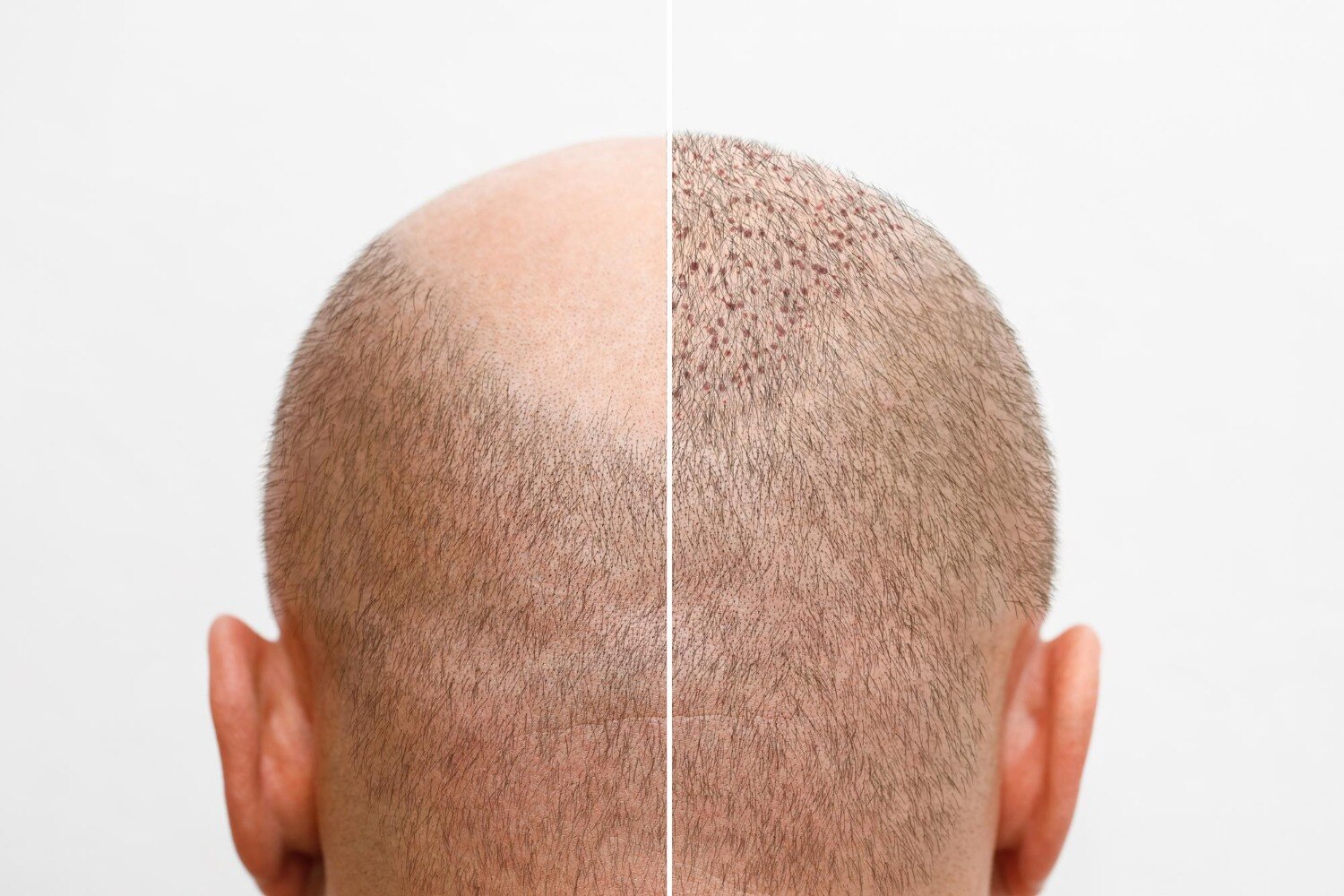
During FUE, the surgeon numbs the scalp, removes individual follicular units from the donor area with a small punch, prepares recipient sites, and places the grafts to match existing hair direction. A hair transplant for thinning hair redistributes follicles; it does not create new ones.
Do not approve a plan that uses the entire donor reserve to fill a crown or early recession.
- Expect tiny wounds, crusting, redness, tenderness and swelling during the first days. Shedding of transplanted hairs can occur during the first few weeks; new growth usually becomes visible around three to four months.
- Treat hair transplant donor area healing as separate from cosmetic recovery. Numbness, altered sensation or patchy redness can last for weeks, and FUE can leave many small, permanent scars.
- Avoid judging density before six months. Assess the developing result at nine to twelve months, with some patients requiring up to eighteen months for the final appearance.
- Ask Dr Girish A C to show the planned hairline, graft count, donor photographs and how much donor hair will remain for future loss before you consent.
| FUE | Removes individual follicular units; leaves many small wounds and scattered scars | Suits patients wanting a shorter linear scar, but overharvesting can create a moth-eaten donor appearance |
|---|---|---|
| FUT | Removes a strip and closes it with sutures or staples, leaving a linear scar | Can preserve more surrounding donor density, but scar visibility and tightness matter |
| No surgery yet | Uses medical treatment while hair loss stabilises | Appropriate when thinning is active or the donor area is also weakening |
Related services
Hair Transplantation Regain your confidence with advanced Hair Transplantation by Dr. Girish A C, a renowned expert in aesthetic restoration. View service → |
Hair Transplant Dr. Girish A C – Expert in Eyebrow Hair Transplant in Bangalore Dr. View service → |
Frequently asked questions
Which pattern of thinning can a hair transplant address?
A transplant best addresses a diagnosed, stable pattern with a defined area of loss and enough healthy donor follicles. Diffuse thinning across the scalp needs more caution because moving follicles can reduce donor coverage without creating new hair.
What must be diagnosed before considering a hair transplant for thinning hair?
A clinician should assess the cause and stability of the loss before surgery. The evaluation can distinguish pattern hair loss from conditions such as alopecia areata, scalp inflammation, nutritional deficiency or active shedding that needs treatment first.
Can the donor area support the coverage you want?
The donor area must contain enough dense, reliable follicles to cover the planned area while preserving a natural appearance. A consultation should compare donor density, hair calibre, hair characteristics and the size of the thinning zone with your coverage goal.
Why is a thinning crown a demanding transplant area?
The crown often needs careful angle, direction and graft placement to create a natural-looking swirl. It also consumes donor follicles over a broad area, while continuing hair loss around the transplanted zone can change the result.
When can you judge the result after FUE?
FUE removes individual follicular units for placement in thinning areas. Early shedding can occur after surgery, and visible growth develops gradually, so assess the result only after the transplanted hairs have had time to mature rather than during the early healing period.
Keywords