A natural-looking result depends less on choosing the deepest dimple and more on creating a controlled tether that appears with your smile, then softens when your face relaxes. By comparing dimple types, one- versus two-dimple designs, surgical methods and healing behaviour, you can ask for a plan that suits your facial movement rather than copying a reference photograph.
Key takeaways
- Choose a dynamic cheek dimple that appears mainly when you smile.
- Follow your natural smile line when selecting one or two dimples.
- Ask how the surgeon controls depth, position and movement during healing.
- Confirm how swelling, scars and final settling will be monitored.
The most natural option is a dynamic cheek dimple
A dynamic cheek dimple usually looks most natural: it appears mainly when you smile, then softens or disappears when your face relaxes. A sharply deep depression visible at rest can look fixed, over-tightened and less like a natural facial movement.
The answer to which dimple surgery option looks natural in Bengaluru depends on anatomy, cheek movement, placement and controlled depth—not on Bengaluru itself. The same applies to dimple surgery options in Bengaluru: no dimple type is inherently more natural because of location.
| Option | Appearance | Main consideration |
|---|---|---|
| Cheek dimple | Shows with smiling | Usually suits a natural-looking dimple |
| Chin dimple | Sits in the chin’s central contour | Different anatomy and movement |
| Unilateral | One cheek only | Suits intentional asymmetry or an existing natural dimple |
| Bilateral | Both cheeks | Creates balance, but not guaranteed identical results |
The commonly used intraoral dimpleplasty uses a small incision inside the cheek and fixation between deeper cheek tissue and the skin’s underside. Percutaneous needle or suture techniques work through the skin without a formal intraoral incision, while open tissue-based techniques remove or release tissue before fixation.
These are different dimple creation types, and none is universally best.
Ask for a dynamic plan rather than maximum depth. An overly tight tether can leave puckering or a deep mark at rest, while healing and individual facial anatomy influence the final result.
Choose one or two dimples by following your smile line
One dimple suits an intentionally asymmetric look, while two dimples suit a preference for balance. Choose based on your existing smile, not on a standard template.
| Choice | Best fit | Planning point |
|---|---|---|
| One dimple | An intentionally asymmetric look or a new dimple beside an existing natural dimple | The surgeon can plan its side independently |
| Two dimples | A balanced appearance when both cheeks move and have suitable anatomy | Compare position and depth across both sides |
For dimple surgery for one or two dimples, the surgeon marks your cheek while you sit upright and smile naturally. The mark is then checked with your face relaxed, because a position that looks attractive during a smile may sit too high, too low or too close to the mouth when your expression changes.
Assessment includes cheek fullness, skin quality, muscle movement, existing smile asymmetry and your preferred appearance. A natural looking dimple usually follows the way your cheek lifts rather than sitting at a fixed distance from the mouth.
Matching both sides on paper does not guarantee identical dimples. Different soft-tissue thickness, muscle pull and pre-existing asymmetry can make one side deeper or more visible. A copied photograph or fixed measurement ignores those differences and can create a dimple that moves unnaturally.
Ask to see the marks while smiling and at rest before agreeing to one side or both.
What the operation actually changes inside the cheek
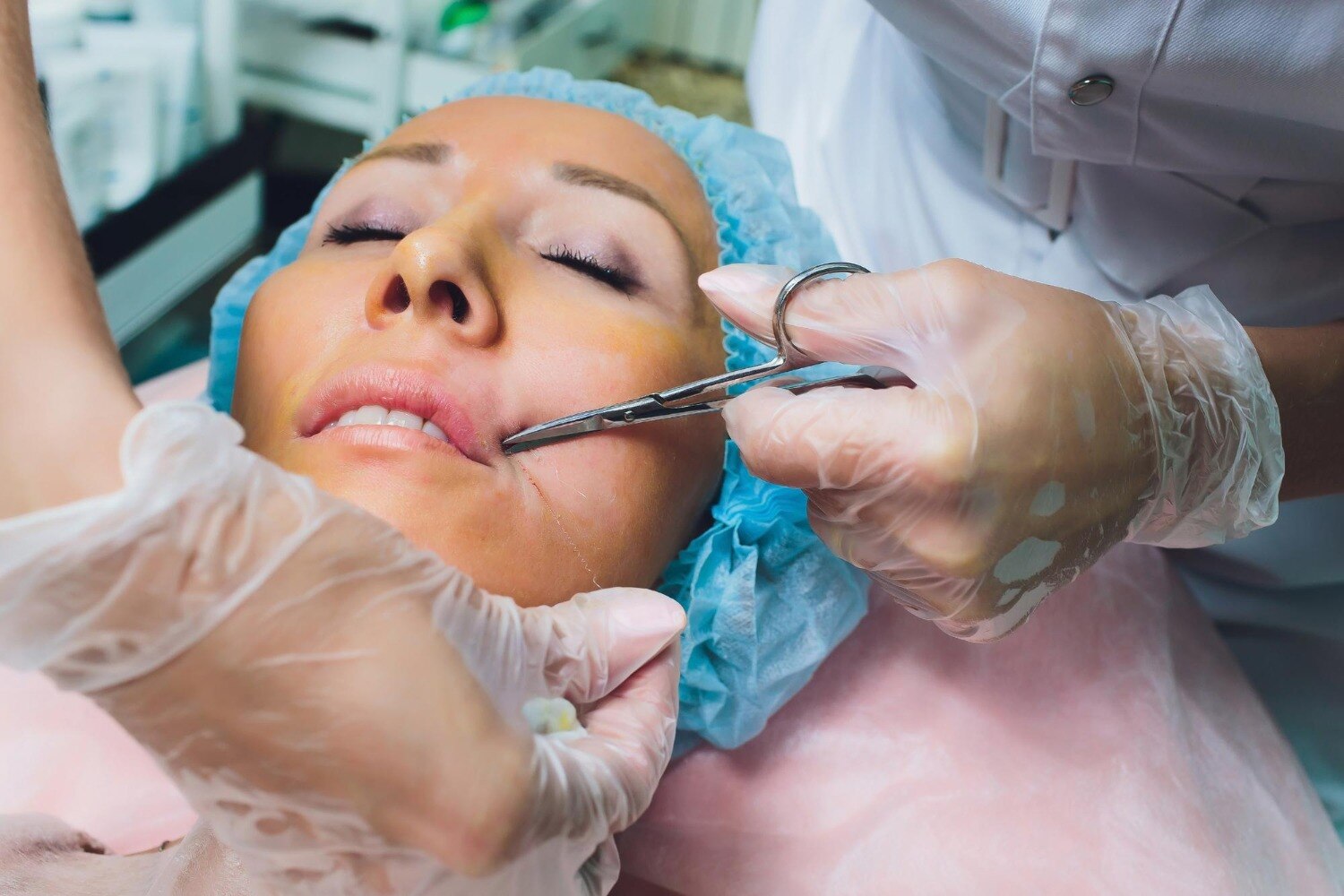
A smile-dependent dimple comes from a controlled tether, not a hole in the skin. In a transoral method, the surgeon makes a small incision inside the cheek, passes an absorbable or non-absorbable suture between deeper cheek tissue—often near structures involved in smile movement—and the underside of the skin.
As healing forms scar tissue around that connection, the skin draws inward mainly when the cheek moves.
Because the incision is inside the mouth, an intraoral approach normally avoids a visible external skin scar. The wound still meets saliva and oral bacteria, so follow the surgeon’s instructions for mouth cleaning, food, and infection symptoms.
| Option | What it changes | Smile-dependent tether |
|---|---|---|
| Surgical dimple creation | Fixes deeper cheek tissue to the skin underside with intended permanence | Yes, but it can soften, distort or disappear if fixation or healing fails |
| Makeup or non-surgical contouring | Adds a visual shadow or indentation | No; reversible and expression-independent |
| Cheek piercing | Places jewellery through cheek tissue | No; reversible, with piercing and scar risks |
These are different dimple creation types, not interchangeable names. A permanent-intent surgical fixation cannot guarantee a permanent result: excessive tension can cause puckering or a mark visible at rest, while weak fixation can fade.
Dimple surgery options in Bengaluru therefore need assessment of muscle movement, cheek anatomy and the depth that suits your smile—not maximum depth.
Healing determines whether the final result looks natural
An early dimple often looks deeper, sharper and more noticeable at rest than the final result. Swelling, bruising and tight fixation can pull the skin inward, creating a prominent mark before the tether softens.
As healing advances, the depression should usually become less rigid and more expression-dependent: clearer when you smile, softer or absent when your face relaxes. Do not judge the result too soon, request maximum depth, or expect an exact copy of a photograph; cheek anatomy, muscle movement and skin healing differ.
Ask the operating surgeon for timing based on your procedure, fixation and examination rather than relying on a fixed promise.
Contact the surgeon for review if you notice:
- Worsening pain, spreading redness, fever or discharge.
- A wound that remains open, repeatedly breaks down or fails to settle.
- Suture visibility or extrusion, especially through the mouth or skin.
- Severe asymmetry, misplaced pulling or a dimple that remains excessively deep.
- Persistent puckering or a mark that stays sharply visible at rest.
A scar-free outer skin surface does not mean the procedure has no risks. An intraoral wound can develop infection or healing problems, and fixation can loosen, fade or leave excessive tethering. A natural looking dimple depends on controlled depth and movement, not the deepest possible indentation.
Questions to ask before choosing a Bengaluru surgeon
Compare dimple surgery options in Bengaluru by asking who will perform the procedure, not only which clinic schedules it. Verify the doctor’s registration through the Indian Medical Register or the relevant state medical register.
A consultation with Dr Girish A C can help you discuss design, movement and recovery questions rather than simply request a standard dimple.
| Question | What to clarify |
|---|---|
| Who operates? | Name the operating doctor and confirm registration. |
| Dynamic or fixed? | Ask whether the dimple should appear mainly while smiling or remain visible at rest. |
| What fixes it? | Identify the suture or other fixation material, and whether it is absorbable or non-absorbable. |
| One or two? | For dimple surgery for one or two dimples, ask how each side will be marked while you sit, smile and relax your face. |
| What if it changes? | Get a plan for a dimple that fades, stays too deep, becomes misplaced or turns asymmetric. |
- Ask how cheek fullness, muscle movement, skin quality and existing smile asymmetry affect the mark; copied photographs and fixed measurements can place it too high, too low or too close to the mouth.
- Ask whether revision, suture removal or observation is appropriate if the result changes, and what each option involves.
Before choosing, understand infection, intraoral wound problems, pain, asymmetry, misplaced depth, suture visibility or extrusion, loss of the dimple and rare nearby-structure injury, including to the parotid duct or facial-nerve branches.
Related services
Face Care Dimple Creation Surgery Specialist in Bangalore Dr. Girish A C is a renowned board-certified plastic and cosmetic surgeon offering expert dimple... View service → |
Face Care Curls & Curves Cosmetic Surgery Centre offers personalized dimple creation surgery in Bangalore under the care of Dr. View service → |
Frequently asked questions
Which dimple surgery option looks most natural?
A dynamic cheek dimple usually looks most natural because it appears mainly during smiling and softens when your face relaxes.
Should you choose one or two dimples?
Follow your smile line and facial balance. One dimple can look more subtle, while two dimples create symmetry when their position suits your cheeks.
What does dimple surgery change inside the cheek?
The operation creates a controlled connection between the cheek skin and deeper tissue, so smiling pulls the skin inward and forms the dimple.
How does healing affect the final appearance?
Swelling, tightness and a dimple visible at rest can change as tissues settle. Follow aftercare instructions and judge the result after healing progresses.
What should you ask a Bengaluru surgeon before dimple surgery?
Ask about the dimple type, placement, depth control, one-versus-two-dimple planning, healing timeline, risks, revision policy and examples of healed results.
Keywords